RESEARCH ARTICLE
Doi: 10.5578/tt.20925
Tuberk Toraks 2016;64(3):217-222

Adolesan ?ğrencilerin sigara i?me ile ilgili davranışları ve g?r?şleri
?zlem Saniye İ?MELİ1, Hatice T?RKER1, Baran G?NDOĞUŞ1, Merve ?İFTCİ1, ?lk? AKA AKT?RK1
1 S?reyyapaşa G?ğ?s Hastalıkları ve G?ğ?s Cerrahisi Eğitim ve Araştırma Hastanesi, G?ğ?s Hastalıkları Kliniği, İstanbul, T?rkiye
1 Clinic of Chest Diseases, Sureyyapasa Chest Diseases and Chest Surgery Training and Research Hospital, Istanbul, Turkey
?ZET
Adolesan ?ğrencilerin sigara i?me ile ilgili davranışları ve g?r?şleri
Giriş: Sigara, d?nyada ve T?rkiye'de ?nlenebilir hastalık, sakatlık ve ?l?mlerin en ?nemli nedenlerinden biridir. ?alışmamızda, adolesan ?ğrencilerin, sigara kullanma bağımlılıkları, sigarayı bırakma konusundaki d?ş?nceleri, sigaranın v?cutta hangi organa zarar verdiği ile ilgili bilgilerinin belirlenmesi ama?lanmıştır.
Hastalar ve Metod: İstanbul ili Anadolu yakasındaki ?zel bir ?niversite hazırlık dershanesi ?ğrencilerine uygulanan ankette ?ğrencilerin demografik ?zellikleri, kendilerinin, ailelerinin ve arkadaşlarının sigara i?me bağımlılıkları, sigaraya başlama nedenleri, sigarayı bırakmayı isteyip istemedikleri, bırakmayı deneyip denemedikleri ve sigaranın zararlı olduğunu bildikleri organların hangisi oldukları ile ilgili sorular soruldu. Elde edilen veriler The Statistical Pockage for the Social Sciences (SPSS) for Windows programı ile değerlendirildi.
Bulgular: Anketleri eksiksiz cevaplamış 358 ?ğrencinin 152 (%42.4)'si erkek ve 206 (%57.6)'sı kız olup 264 (%73.7)'? halen lise ?ğrencisi, 94 (%26.3)'? lise mezunu idi. ?ğrenciler 16-20 yaş aralığında olup ortalama yaş 18 ? 1.15 idi. Sigara i?me bağımlılıkları sorulduğunda erkek ?ğrencilerin 54 (%15.2)'?, kız ?ğrencilerin 30 (%8.4)'u olmak ?zere toplam 84 (%23.5) ?ğrenci aktif olarak sigara i?meye devam ediyordu. Toplam 14 ?ğrenci (%3.9) sigara i?ip bırakmış, 260 (%72.6) ?ğrenci ise hi? i?memişti. Sigaraya başlamada en sık belirtilen neden meraktı (%39), ikinci sırayı ise arkadaşları sigara i?tiği i?in (%30.6) sigaraya başladığını belirtti.
Sonu?: Gen?lerimiz giderek daha k???k yaşlarda sigaraya başlamakta ve bu k?t? bağımlılığın sorunlarını yaşamlarının sonraki yıllarına aktarmaktadırlar. Batı toplumlarının yaklaşımını ?rnek alarak hem devlet hem de toplum olarak sigarayı ?zendirici eylemlere ve koşullara karşı kararlılıkla m?cadele etmeli ve gen?lerin bu zararlı bağımlılıktan kurtulabilmesi i?in destek verebilecek kurumlara, ulaşabilmelerini kolaylaştıracak adımlar atılmaya devam edilmelidir.
Anahtar kelimeler: Sigara i?me, adolesan, ?ğrenci
SUMMARY
Behaviours and opinions of adolescent students on smoking
Introduction: Smoking is one of the major causes of preventable diseases, disability and death in the globe and Turkey. In our study, the knowledge of students about smoking addiction and which organ in the body is damaged due to smoking are aimed to be determined.
Patients and Methods: Surveys were applied to students of private university preparatory training center on the Anatolian side of Istanbul. In the conducted survey, the questions related with students' demographic characteristics, themselves, their families and friends smoking addiction, the reasons to start smoking, whether they want to quit smoking, whether they try to quit smoking and which of the organs that they know smoking is harmful were asked. The data obtained were transferred to the Statistical Package for the Social Sciences (SPSS) for Windows.
Results: Out of 358 students who answered the survey completely, 152 students (42.4%) were male, 206 (57.6%) were female. Students were between the ages of 16-20 and the mean age was 18 ? 1.15. When asked about their smoking addiction, 84 (23.5%) of total actively continued to smoke. Total of 14 students (3.9%) smoked and then stopped smoking, 260 students (72.6%) have never smoked. Curiosity was the most commonly reported reason to start smoking (39%) and for the second row, they indicated to start smoking due to tobacco user friends (30.6%).
Conclusion: More and more young people begin smoking at an earlier age and they transfer the problems of this bad addiction to the later years of their lives. There should be fight resolutely against actions and conditions encouraging smoking both as a state and society and in order to rescue young people from this bad addiction, it should continue to take steps which facilitate accessibility to supportive institutions.
Key words: Smoking, adolescent, student
Geliş Tarihi/Received: 19.12.2013 - Kabul Ediliş Tarihi/Accepted: 17.04.2016
INTRODUCTION
Smoking is one of the major causes of preventable diseases, disability and death in the globe and Turkey. Although it is known to be the origin of many diseases with high mortality, use of smoking is still an important public health problem (1). According to the Global Adult Tobacco Survey (GATS) of 2012, 27.1% of adults and 8.4% of young people in our country are active smokers (2). In developing countries such as Turkey, it is emphasized that the prevalence of smoking among young people increases dramatically (3). Studies shows that the majority of smokers in many countries started smoking before the age of 18 (3,4). Starting smoking at an early age leads to health problems soon. Reasons for young people to start smoking such as peer pressure, mother's, father's or sibling's smoking, smoking of people they care play a encouraging role to start smoking (5,6). Anti-smoking education programs have been shown to be effective on the prevention of tobacco use (7).
In our study, the knowledge of students attending private university preparatory training center about smoking prevalence, age of starting smoking, reasons to smoke, thoughts about quitting smoking, Which organ in the body is damaged due to smoking are aimed to be determined.
PATIENTS and METHODS?
By accessing the managers of private university preparatory training center on the Anatolian side of Istanbul, they were informed about the study and permission was obtained. It was not taken ethic committee approval. Prior written informed consent was obtained from all students. Students to whom the survey will be applied were informed and their consents were taken.
Following a review of the respective literature, a 15-item questionnaire was developed to identify attitude and behaviour of students towards smoking, and reflect their level of knowledge about smoking-related harms (8-10).
Surveys were distributed to the students and were asked to answer the survey forms by themselves and not to write their names and numbers. In the conducted survey, the questions related with? students' demographic characteristics, themselves, their families and friends smoking addiction, the reasons to start smoking, whether they want to quit smoking, whether they? try to quit smoking and which of the organs that they know smoking is harmful were asked (Appendix 1. Survey).
The data obtained were transferred to the Statistical Package for the Social Sciences (SPSS) for Windows. Defining characteristics of the data were expressed as mean ? standard deviation, number and percentage.
RESULTS
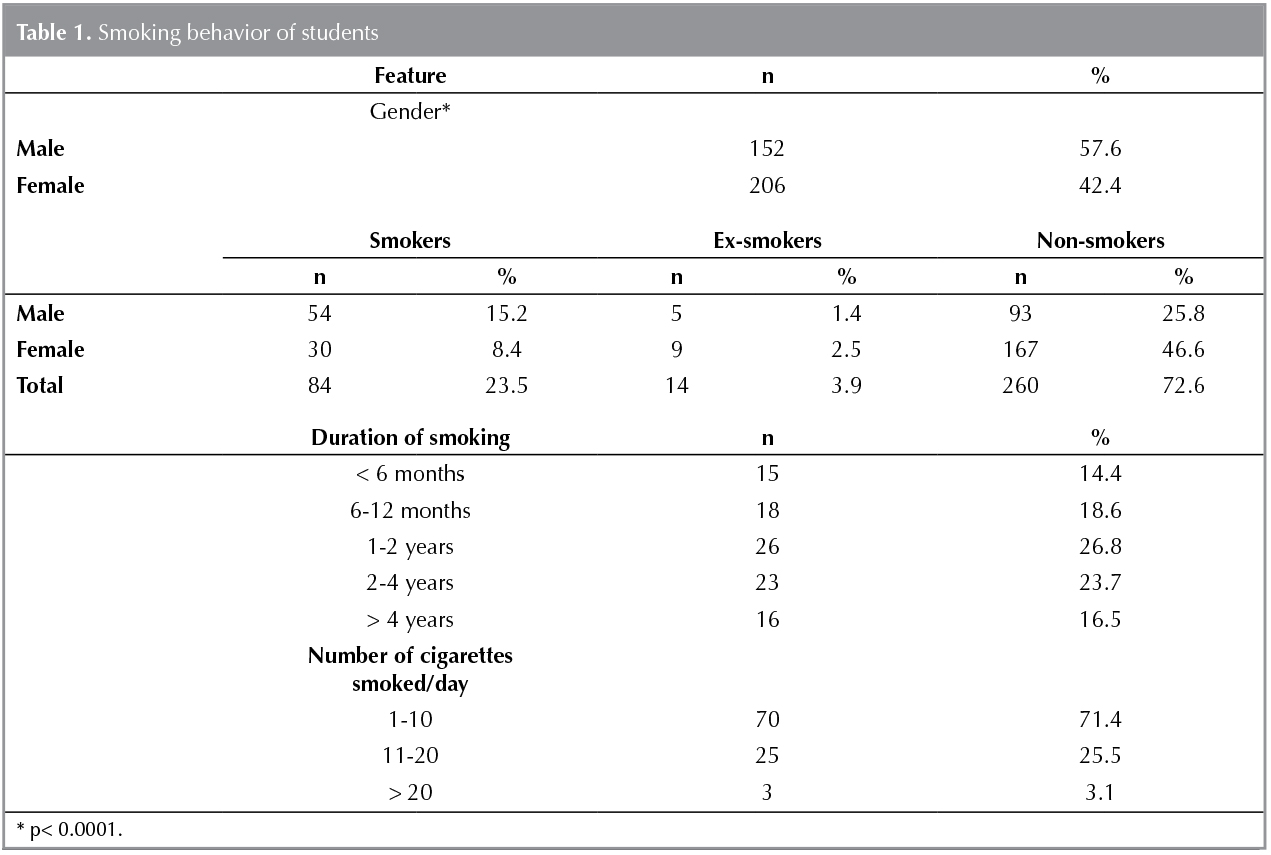
Out of 358 students who answered the survey completely, 152 students (42.4%) were male, 206 (57.6%) were female, 264 students (73.7%) were still at high school and 94 students (26.3 %) were high school graduates. Students were between the ages of 16-20 and the mean age was 18 ? 1.15. When asked about their smoking addiction, 54 (15.2%) of male students and 30 (8.4%) of female students, 84 (23.5%) of total actively continued to smoke. Smoking addiction does not show significant difference according to gender (p< 0.0001). Male students were smoking more than female students; this can be interpreted as a significant relationship between gender and smoking addiction. Higher smoking rate in male students than the one in female students showed correlation with the studies about this issue (11,12).
Total of 14 students (3.9%) smoked and then stopped smoking, 260 students (72.6%) have never smoked. The age of starting smoking among total 98 students who smoked and then stopped smoking was found to be as 15.89 ? 1.80. The age of experiencing smoking for the first time was found to be 9. Smoking duration was less than 6 months for 15 students. Duration of smoking was 6-12 months for 18 students, 1-2 years for 26 students, 2-4 years for 23 students, 4 years for 16 students (Table 1).
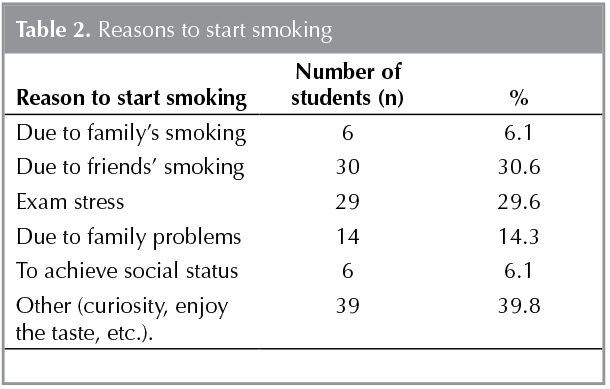
When queried the reasons to start smoking, Table 2 shows the reasons. Curiosity was the most commonly reported reason to start smoking (39%) and for the second row, they indicated to start smoking due to tobacco user friends (30.6%). There was no statistically significant relationship between students' smoking and smoking their families and friends.
When we asked to the current smokers (84 students) whether they intend to quit smoking, 37 students (44%) responded positively and 42.9% of these students had tried to quit smoking before.
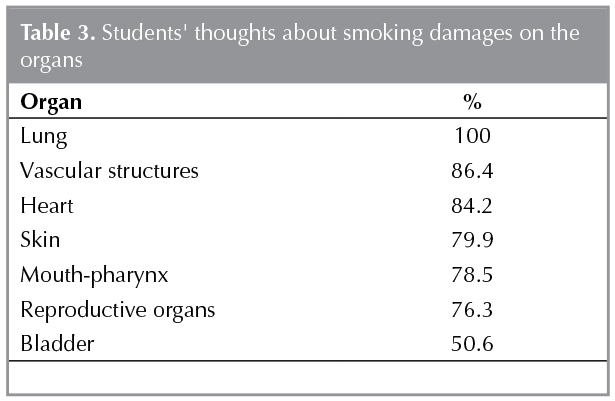
When students were asked about the health hazards of smoking and to which organs smoking damages the body, answers given by the students were indicated in Table 3.
DISCUSSION
Smoking is a behavior that adversely affects human health. Most health-related behaviors develop during childhood and adolescence (13).
According to the Global Adult Tobacco Survey (GATS) of 2012, 27.1% of adults over 15 years in our country, approximately 16 million people, are currently smoking, 41.5% of males and 13.1% of female smoke. Although the legal age of buying cigarettes in Turkey is 18, 58.7% of daily smokers are under the legal age. 61.8% of the males, 49% of females start smoking before the age of 18. Age of smoking initiation among males is 16.8 and among females is 17.9. It is reported that 8.4% of students (10.2% male, 5.3% female) are smoking (2). In our study, 54 (15.2%) of male students and 30 (8.4%) of female students were smoking, and the higher smoking rate in males than female students show parallelism with other studies (11,12,14). In Europe and the United States of America, it was reported that tobacco use among high school students was similar and varied between 12.3% and 31.2% (15,16).
In our study, age of starting smoking was 15.89 ? 1.80, it was 13.2 ? 2.7 in Manisa, and it was found to be 12.4 ? 2.5 in Afyon; the results were similar (17,18).
There are studies showing that whether there is an association between the situation of young people starting to smoke and smoking addiction of mother and father (17). Akpınar et al indicated in their study that the most important factor affecting the initiation of smoking is friends' smoking (19). In our study, the relationship between families' or friends' smoking, as a reason to start smoking, and students' smoking was not determined. The reasons to start smoking were indicated as curiosity, enjoying the taste and boredom. This situation was compatible with the study conducted in Manisa (17).
In our study, 44% of students who smoke thought to quit smoke and 42.9 of these students have tried to quit smoking. In the studies conducted in D?zce and Manisa, smoking cessation rates was found to be 78.6% and 77.7%, respectively. It was pointed out that over the years, the desire to quit smoking was found to be decreased (17,20).
Smoking leads to many diseases, especially cardiovascular diseases (21). In our study, when students who smoke were asked about which organs were harmed by smoking, it was seen that 100% of students know smoking is harmful to lungs and causes respiratory system diseases.
In Conclusion students who smoke, continue to their smoking addiction although they know hazards of smoking. To reduce smoking-related diseases, deaths, it is important to reduce the rate of smoking initiation. Young people should be educated about smoking at the earliest possible age and educational programs to prevent smoking should be made.
More and more young people begin smoking at an earlier age and they transfer the problems of this bad addiction to the later years of their lives. There should be fight resolutely against actions and conditions encouraging smoking both as a state and society and in order to rescue young people from this bad addiction, it should continue to take steps which facilitates accessibility to supportive institutions.
Conflict of Interest
There is no conflict of interest.
REFERENCES
- Karlıkaya C, ?ztuna F, Solak ZA, ?zkan M, ?rsel O. Tobacco control. Journal of Toraks 2006;7:51-64.
- The Ministry of Health of Turkey Global Adult Tobacco Survey Turkey Report-2012.
- World Health Organization. Health Education 2009. Access date: 01.06.2012. Available from: http:www.who.int/tobacco/en/atlas33.pdf.
- Warren CW, Riley L, Asma S, Eriksen MP, Green L, Blanton C, et al. Tobacco use by youth: a surveillance report from the Global Youth Tobacco Survey project. Bull World Health Organ 2000;78:868-76.
- Buller DB, Borland R, Woodall WG, Hall JR, Burris-Woodall P, Voeks JH. Understanding factors that influence smoking uptake. Tob Control 2003;12:16-25.
- Alexander C, Piazza M, Mekos D, Valente T. Peers schools and adolescent cigarette smoking. J Adolesc Health 2001;29:22-30.
- Centers for Disease Control and Prevention (CDC). Effectiveness of initiative -Oregeon, 1999-2000. MMWR 2001;50:663-6.
- Currie C, Hurrelmann K, Settertobulte W, Smith R, Todd J. Health behaviour in school aged children. A WHO cross-national study. International report. WHO health policy for children and adolescents series No 1. 2000.
- Piko PF, Luszczynska A, Gibbons FX, Tekozel M. A culture-based study of personal and social influences of adolescent smoking. Eur J Public Health 2005;15:393-8.
- Wang MQ. Social environment influences on adolescents' smoking progression. Am J Health Behav 2001;25:418-25.
- D?nmez B, ?olak H, D?nmez KH. Investigation of smoking, alcohol and drug habits of high school students in the province of Giresun. Black Sea Journal of Social Sciences 2010;3:35-42.
- G?kg?z Ş, Ko?oğlu G. The effects of education related with smoking on adolescent period. Firat Medical Journal 2009;14:33-41.
- ?zcebe H. Risky behaviors in adolescents. In: Derman O, Kanbur N?, Akg?l S (eds). Ergen Sağlığı. Ankara: Aydoğdu Ofset, 2012:167-80.
- Bayrak U, Gram E, Mengeş E, Okumuş ZG, Sayar HC, Skrijelj E, et al. College students' knowledge and attitudes about cancer and health-related habits. DEU Journal of Medicine 2010;24:95-104.
- Dube SR, Arrazola RA, Lee J, Engstrom M, Malarcher A. Pro-Tobacco Influences and susceptibility to smoking cigarettes among middle and high school students-United States, 2011. Journal of Adolescent Health 2013;52:S45-S51.
- Ferrante M, Fiore M, Leon L, Costantidines F, Castaing M, Fallico R, et al. Age of smoking initiation, tobacco habits and risk perception among primary, middle and high school students in Southern Italy. IJPH 2010;7:262-7.
- ?elik P, Esen A, Yorgancıoğlu A, Şen SF, Top?u F. High school students' attitudes towards smoking in Manisa. Journal of Toraks 2000;1:61-6.
- Orman A, Şen TA, Doğan N, Tuncer GZ. Factors affecting the cigarette smoking habits among students in Afyon-Turkey. Akciğer Arşivi 2004;1:15-9.
- Akpınar E, Yoldaşcan E, Saat?i E. The smoking prevalence and the determinants of smoking behavior among students in Cukurova University, Southern Turkey. West Indian Med J 2006;55:414-9.
- Arbak P, Erdem F, Karacan ?, ?zdemir ?. Smoking habit of high school students in Duzce. Solunum (Respiration) 2000;2:17-21.
- Erbaydar T, Avcı S, Altay G. Attitutes of teachers about smoking in the school environment and students' smoking. M? Atat?rk Faculty of Education Journal of Educational Sciences 2003;17:63-74.
Yazışma Adresi (Address for Correspondence)
Dr. ?zlem Saniye İ?MELİ
S?reyyapaşa G?ğ?s Hastalıkları ve
G?ğ?s Cerrahisi Eğitim ve Araştırma Hastanesi,
G?ğ?s Hastalıkları Kliniği,
İSTANBUL - TURKEY
e-mail: icmeli@superonline.com